¿Qué hora es? (What time is it?)
You're right! Today we are going to work a bit on asking and saying times in Spanish.
Aquí, ahora son las cinco de la tarde (Here, it's five o'clock now)
How would you ask "what time is it?" in Spanish. The most standard option is the one I used earlier, ¿Qué hora es? In Spain, you'd ALWAYS use the singular to ask ¿Qué hora es? but it's my belief that you could ask ¿Qué horas son? in other countries (if you find the moment, it'd be nice to check it with Sebastian)
There are some other ways though to do this. You could say:
¿Me podría decir la hora, por favor? (Literally, Could you please tell me the time?) --> You'd use this to adress an unknown in a public space asking for the time.
¿Qué hora tienes? (Literally, what time do you have?) --> You'd use this in a rather informal context, with friends.
Note that I used "Son las cinco" ("They are five") and we will always use this plural form of verb to be (verbo ser) in plural (son) EXCEPT FOR one is involved in the time (e.g, "Es la una", "es la una y media", "es la una menos cuarto")
The next image provides us the most relevant information!
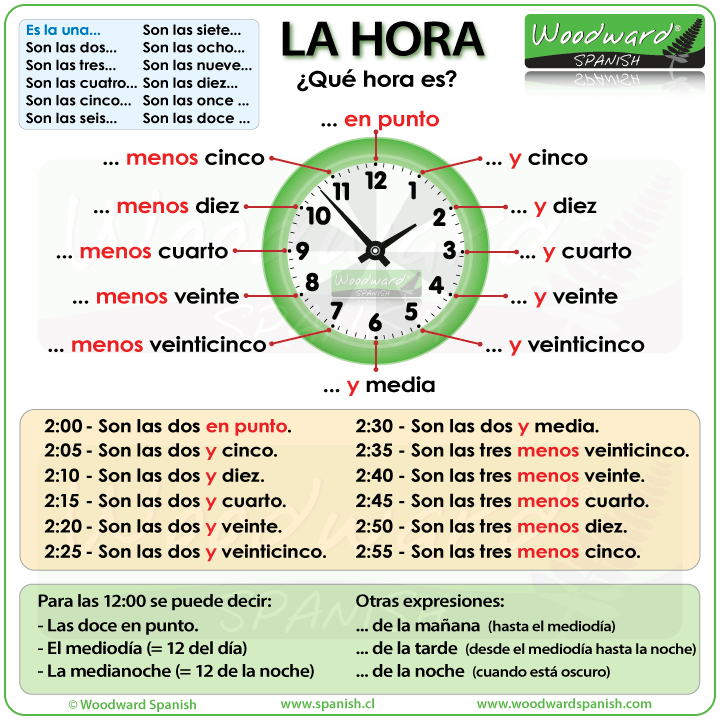
In the green chart, it is said that, for 12:00, we can use
"Medio día" = midday
"Media noche" = midnight
Usually, we "complement" the time by adding the "part of the day" we are in.
So, I'd rather say "Son las cinco de la tarde" (It's five in the evening), "Son las diez y media de la mañana" (It's half past in the morning)...
What I'd recommend you to do is:
1. Design your own picture/diagram in your notebook about how to ask about and say the time.
2. How would you write these times in Spanish?
3:35 p.m.
1:15 p.m.
8:00 a.m.
10:25 a.m.
6:40 p.m.
Another important point we could include today is the use of prepositions with times...
So, when you ask "What time do you study Spanish?" (¿A qué hora estudias español?) you would answer "At ______"
How do we say this "at" in English? The preposition used in Spanish is a (followed by the time as it has been explained earlier).
Examples:
¿A qué hora estudias español? (What time do you study Spanish?)
A las diez de la mañana (At 10 o'clock in the morning)
¿A qué hora tomáis café? (What time do you have coffee?)
A mediodía (At midday = At 12:00 p.m)
¿A qué hora es el partido?) (What time is the game?)
A las seis y media de la tarde (At 18:30 p.m)
Lastly, there is another situation in which we are likely to use a different preposition: de. When?
If you ask, "When is your zumba class?" (¿Cuándo es tu clase de zumba?) You could say "From 5 to 6" (De cinco a seis)
Note that here you use "a" with a different meaning (to, not at anymore).
Examples:
¿Cuándo entrenas? (When do you work out?)
De siete y media a ocho y media de la tarde (From 19:30 to 20:30)
¿Cúando es la película? (When is the movie?)
De diez a doce de la noche más a o menos (From 22:00 to 24:00 more or less)
3. Try to answer the following questions in Spanish:
What time does Nero open? (¿A qué hora abre Nero?)
What times do kids usually wake up in England? (¿A qué hora se suelen levantar los niños en Inglaterra?)
What times does Andy go to bed? (¿A qué hora se acuesta Andy?)
What time does bus number 93 stop working? (¿A qué hora deja de funcionar el bus 93?)
4. Would you dare to create 2-3 sentences following any of the examples given today?
5. Send me a voice message with your sexy deep voice letting me know what time is it now.
¡Ánimo con la tarea de hoy!


No hay comentarios:
Publicar un comentario